During our passage on the Lipari sailing catamaran, I had the opportunity to practice
mooring. First, I learned how to secure fenders. These are buoy fenders that prevent the
hull from scraping against the dock. They need to be tied using this knot:
This knot is convenient because it easily slides, allowing you to adjust the height of
the fender relative to the hull, as dock heights can vary.
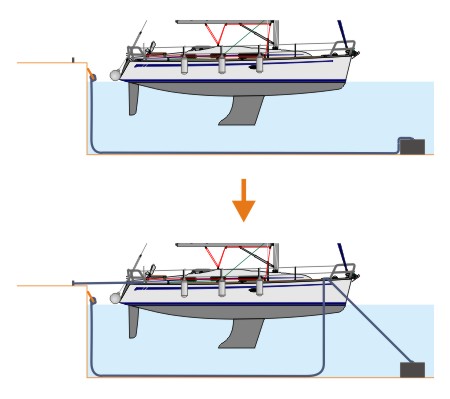
For stern mooring, we usually use lines with permanent attachments on the seabed:
To retrieve the mooring from the bottom, you need to hook a rope connected to it and
covered with a layer of mud onto the dock, and then pull it along the side of the boat
until the mooring appears.
The sequence of actions depends entirely on the wind direction. If the wind is blowing
from the dock, it is logical to first secure the stern, and then tighten the mooring
lines. If the wind is blowing towards the dock, you should set the stern lines and
prevent the boat from hitting the dock with the engines, secure the mooring lines, and
then tighten the stern lines. In this case, the boat should not come too close to the
shore.
Except when stopping for a 10-minute refueling, where it is possible to moor more
tightly.
When the wind is coming from the side, it is the most challenging situation because it
cannot be simply compensated for by the engines. In this case, you can sometimes lean
against a neighboring boat and immediately tighten the opposite stern line and mooring.
Much depends on the situation and the number of helpers on board. If it is possible to
perform all actions quickly and simultaneously from all four corners, it follows one
tactic, but if there are only two people on board, one of whom is at the helm, then
another tactic is used.
Steering on a catamaran during mooring is done only with the engines, and the rudder must
be fixed in the neutral position. You can turn around, rotate in place by engaging one
engine forward and the other in reverse. You can also make slight adjustments by varying
the engine speeds. For example, when moving forward, giving more throttle to the right
engine will cause the catamaran to turn to the left. If you need to approach the dock
and position the boat with the starboard side, you can initiate a rotation by briefly
engaging the left engine in reverse and leaving the right engine in neutral. The
catamaran will turn towards the dock and continue to move sideways due to inertia for a
few more meters. Of course, all maneuvers are done smoothly and at very low speeds.
After mooring, it is common to set up diagonal springs — these are long ropes usually
stretched diagonally or led to distant cleats. The short ends are slackened. The
springs, due to their length, act as springs and thus soften jerks caused by waves or
gusts of wind.
In general, it is customary for yachtsmen to help their neighbors during mooring,
especially in difficult conditions. This is also an opportunity to chat and share
information about your route, where you came from, and where you are headed.
Mooring: The Art of Proper Approach
A Challenge Testing the Skills and Preparation of the Skipper. No Two Moorings Are
Alike.
Indeed, mooring conditions are always variable. The wind, current, marina or harbor
occupancy are constantly changing. Furthermore, the professionalism and coordination of
the crew are also ever-changing characteristics.
Is there any algorithm to follow that can make mooring in the marina a smooth process,
avoiding not only trivial matters but also attempts to deal with the security deposit?
Can mooring in the marina be carried out smoothly and without losses by following
certain rules?
Let’s try to outline a certain scheme and general rules that will help avoid major
mistakes when approaching the mooring in the marina.
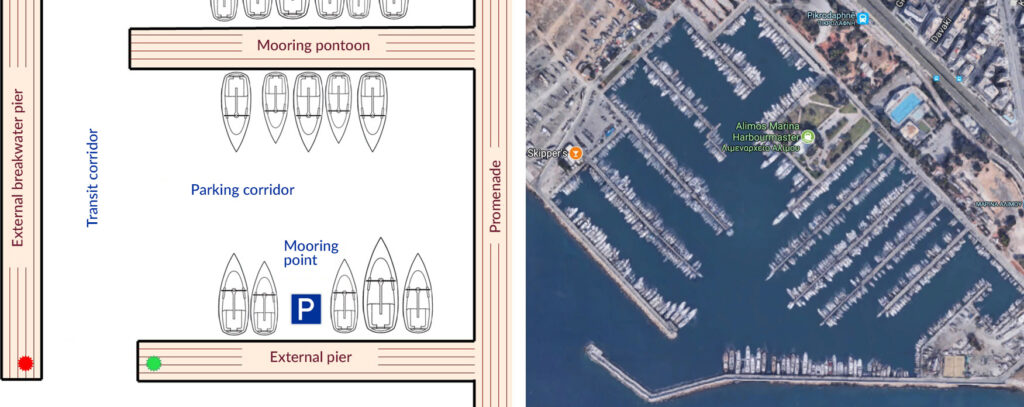
But first, let’s define some terms. Let’s consider the layout of yacht harbors using the
example of a standard Mediterranean marina. The ‘entrance gates’ (entrance of marine)
marked by navigation lights serve as the entrance to the marina: red on the left, green
on the right. Beyond the entrance gates is the main or transit corridor, which leads to
the berthing corridors located between the floating pontoons. It’s understood that this
is just a schematic representation.
However, if you look at Google photos of the Alimos Kalamaki marina in Athens, which
looks quite different from the image on the left, you will easily identify all the
elements indicated on the scheme.
Well, let’s begin the approach for mooring! How should we best pass through the entrance
gates: stern-first or bow-first? Unless we consider specific cases (such as when your
assigned berth is located almost directly across from the entrance gates), you can
approach in whichever way you prefer or as dictated by the conditions, which we will
discuss below.»
However, when entering the berthing corridor between the pontoons, it is generally best
to approach stern-first: it is the correct and professional approach. This method
eliminates the need for intermediate stops and allows for better maneuverability of the
yacht as you bring it to the assigned berth at the dock.
The key to a successful mooring is the yacht’s maneuverability at every moment of the
approach. When moving stern-first towards the mooring spot, the yacht follows a
predictable trajectory. Naturally! After all, it has momentum. And since it is in motion
(at a speed of at least three knots), it is easily controllable.
This applies to almost any wind direction, with one exception. But be patient! We will
discuss this exception a little later.
2. Mastering Spinning Wind Parking
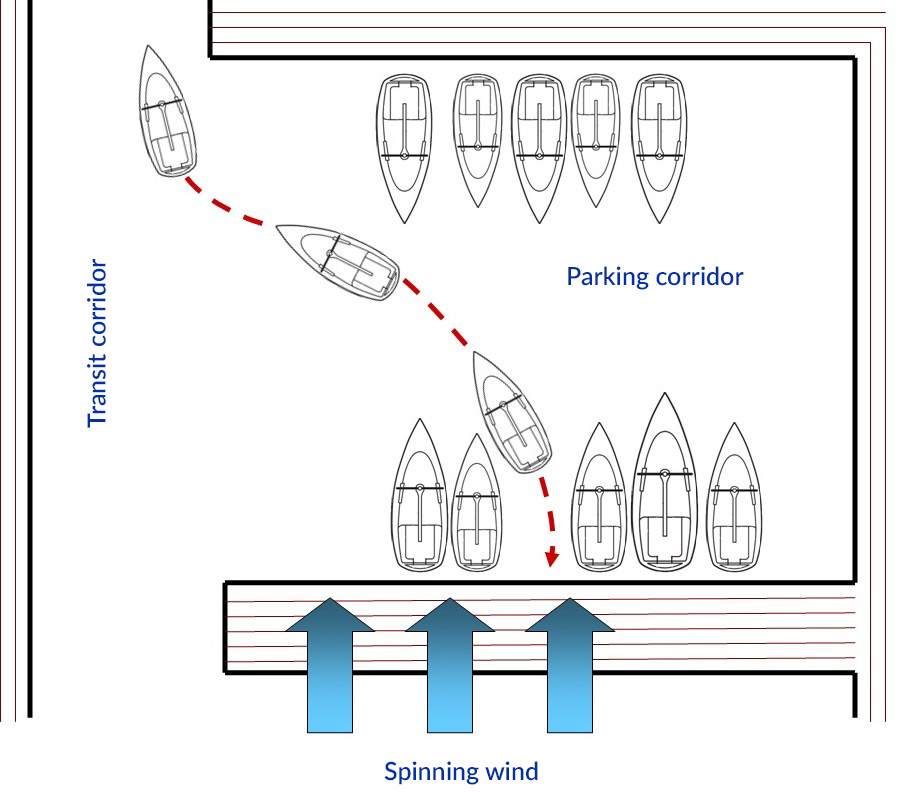
So, we intend to dock in the marina, and the wind is offshore, blowing away from our
assigned berth. What a stroke of luck!
We approach stern-first. As soon as we enter the berthing corridor and expose the stern
to the wind, it starts pushing against the bow of the yacht, attempting to align it like
a weather vane, pointing into the wind. Well, that’s great! In this situation, the wind
will help us effortlessly align the boat perpendicular to the dock.
The yacht moves steadily in reverse. The wind, pressing against the stern of the boat,
helps slow it down before reaching the dock wall. It’s a very favorable wind situation
for us! It’s just a shame that it’s not very common.
2. The Wind Blowing Toward the Pier
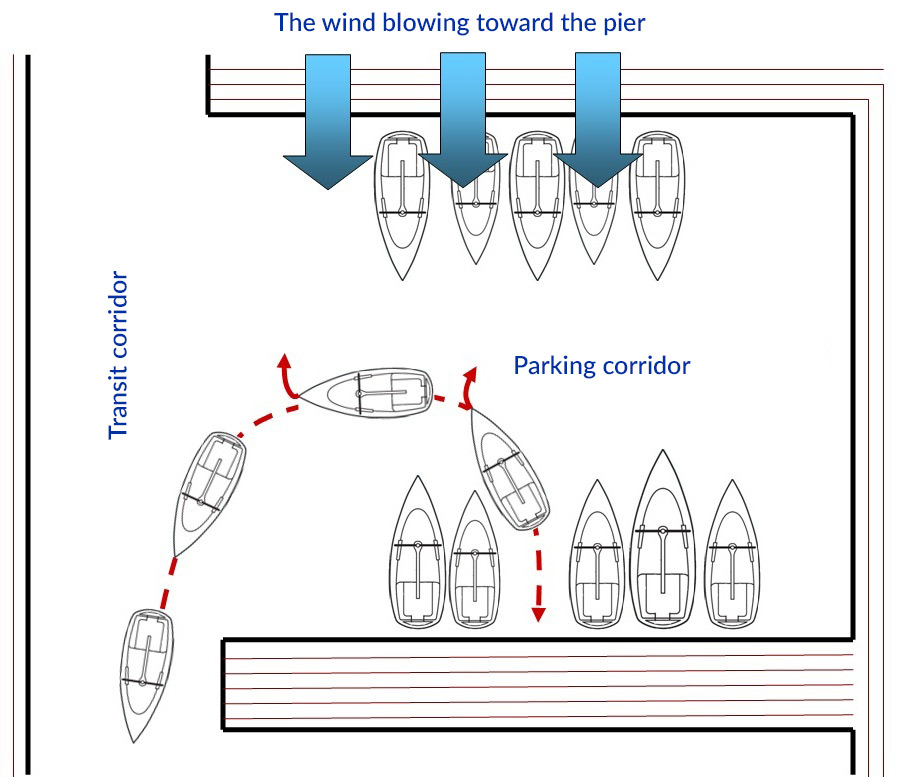
Now, what if we have a headwind? Mooring in such conditions requires precisely calculated
maneuvers and utmost attention from the helmsman. Moving in reverse, it becomes very
difficult to keep the bow of the yacht from veering into the wind. Even the slightest
deviation from the wind line will cause the wind to push against the bow, diverting the
boat from your intended trajectory.
It’s a challenging task, especially in strong winds, and even more so for an
inexperienced helmsman.
Let’s try our luck in this situation as well by entering the berth in reverse.
We begin. The boat enters the berth corridor in reverse from the transit corridor. The
wind blows into the stern, and the yacht effectively starts turning on a circle in
reverse.
Pay attention: in the upper phase of the turn, the boat stands beam to the wind, and
it tries to push the right quarter away from it. But during the turn, the bow of the
boat centrifugally seeks to move outward, outside the circle outlined, thereby
compensating for the pressure of the wind flow on it.
Look, even in this case, everything goes well and smoothly! The yacht moves stably and
controllably in reverse, with the bow not veering into the wind. The danger of the bow
veering into the wind will arise at the last moment when the stern of our yacht is
already close to the dock and in the space between the boats moored at the dock. But
now, this veering is not a threat to us: there is nowhere for it to veer. On both sides,
there are neighboring boats. And besides, everyone, including your yacht, is equipped
with fenders. In general, there is no room for veering.
What if there is somewhere to go? What if the dock is empty during mooring in a headwind?
That’s also great!
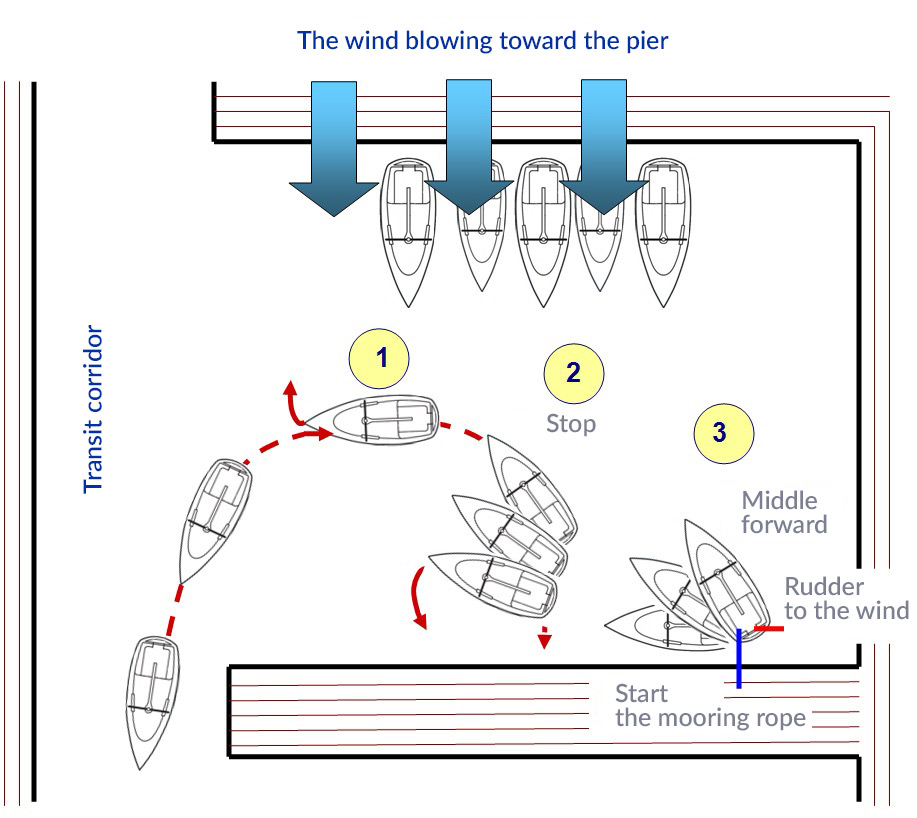
From position (1) (the yacht is moving beam to the wind, continuing the turn).
Simultaneously, the boat starts decelerating with «Ahead Slow (to Half)».
The goal is to stop the yacht in a position where the bow is slightly upwind, and the
stern is close to the dock (pos. 2). Gradually, the wind will blow the yacht towards the
dock (fenders on board!) and press it against it.
After that, the stern line is attached (blue line), the rudder is turned to the maximum
away from the dock (upwind!), and the throttle lever is moved from neutral to «Ahead Mid
(Full)» position (pos. 3). The yacht will turn into the wind. If you want, at this
moment you can assist the turn with the bow thruster, but it’s not necessary in
principle: the process will go on its own. With the bow thruster, perhaps a little
faster.
I separated the pictures of positions (2) and (3) to avoid confusion. In reality, all of
this happens in the same place.
When the boat is perpendicular to the dock (rudder — straight, throttle lever — in the
«Ahead Mid» position) and assumes a stable position, you can calmly raise and secure the
mooring lines.
In the diagram (for clarity), the situation is shown with a leeward mooring. If you
choose a windward mooring, the turn into the wind will be even more confident.
3. Side Wind (wind blowing against the yacht’s movement in the
docking corridor)
When the wind blows against your movement in the docking corridor, approaching
stern-first… that’s right! It’s good here too.
Indeed, we already know that the yacht moves stably and steadily in reverse against the
wind. In fact, it’s so stable that almost in any wind, by adjusting the engine RPM, you
can make the yacht stop and stay against the wind «in reverse.»
The propeller, working in reverse, will compensate for the leeway of the yacht: the wind
will push it forward, while the propeller moves backward. The result of this «push-pull»
is zero speed (SOG=0). And despite this, there won’t be any yawing, as the bow will be
uniformly streamlined by the airflow.
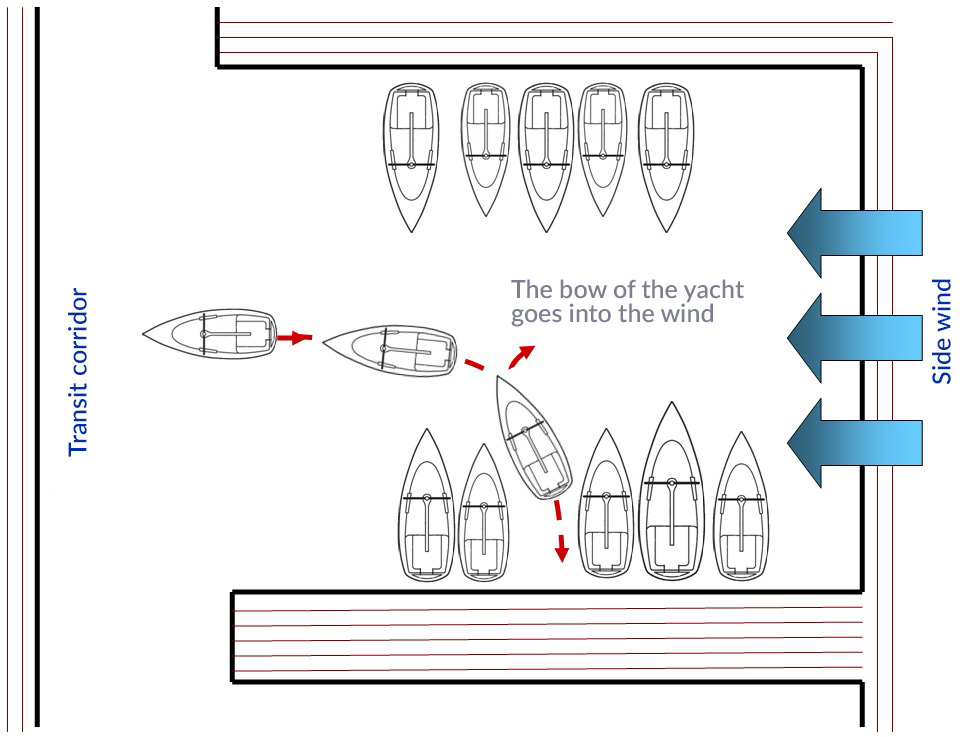
But let’s get back to mooring. During the maneuver to the parking spot, the bow of the
yacht predictably (for you, it’s already predictable!) will turn «into the wind,»
compensating for the undesirable wind effect. The boat approaches the dock along the
trajectory you planned, without any surprises or associated difficulties.
Well, we have reached the very exception I mentioned at the beginning of the article.
It’s time to end the intrigue.
3. Side Wind (wind blowing in the direction of the yacht’s
movement in the docking corridor)
Perhaps there is only one case where it is better to approach the docking corridor
bow-first. And that is when the direction of the wind coincides with the direction of
your movement in the docking corridor. See for yourself.
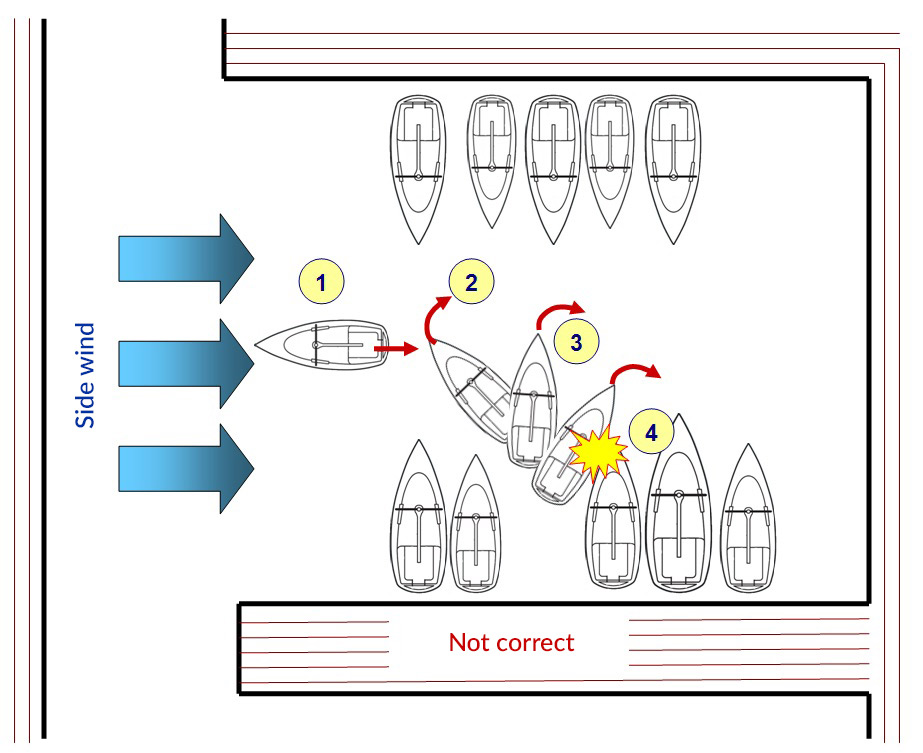
First, let’s consider the incorrect option. The wind is blowing along the dock in the
direction of your movement.
We decided to enter the corridor in reverse (pos. 1). Therefore, when approaching the
parking spot and turning towards the dock, the bow of the boat, due to the laws of
physics (centrifugal force), will tend to turn towards the leeward side (pos. 2, 3).
Taking into account the lightness and the large sail area of the bow section of the
yacht, the wind will contribute to this centrifugal drift.
As a result, the boat will actively «slide» towards the leeward side with its bow. If the
dock is empty, it will «slide» onto the dock, but if you are docking between boats, it
could lean against the neighboring boat or drift towards the mooring line (pos. 4).
Overall, not a desirable outcome, especially if the skipper has limited experience in
docking.
Someone might argue: on the contrary, the wind will help to easily position the bow
correctly, and there will be less need for steering. The key is to start the turn at the
right moment.
I won’t argue with that! The key words in this argument are «at the right moment.» And
for that, one needs significant experience and a deep understanding of the boat.
Undoubtedly, for Captain Ron, it would be right to skip this paragraph, as well as the
entire article: he already knows it all! But we will continue. After all, our task is to
make our lives easier, not complicate things unnecessarily in the final steps towards
checkout.
In this situation, when the wind is blowing along the docking corridor in the direction
of your movement, approaching stern-first is only suitable for confident and experienced
sailors (everyone knows the joke about the experienced sailors, right?). Approaching
bow-first simplifies the task. We will simply try to reduce it to the familiar and
stable maneuver of backing against the wind to the parking spot.
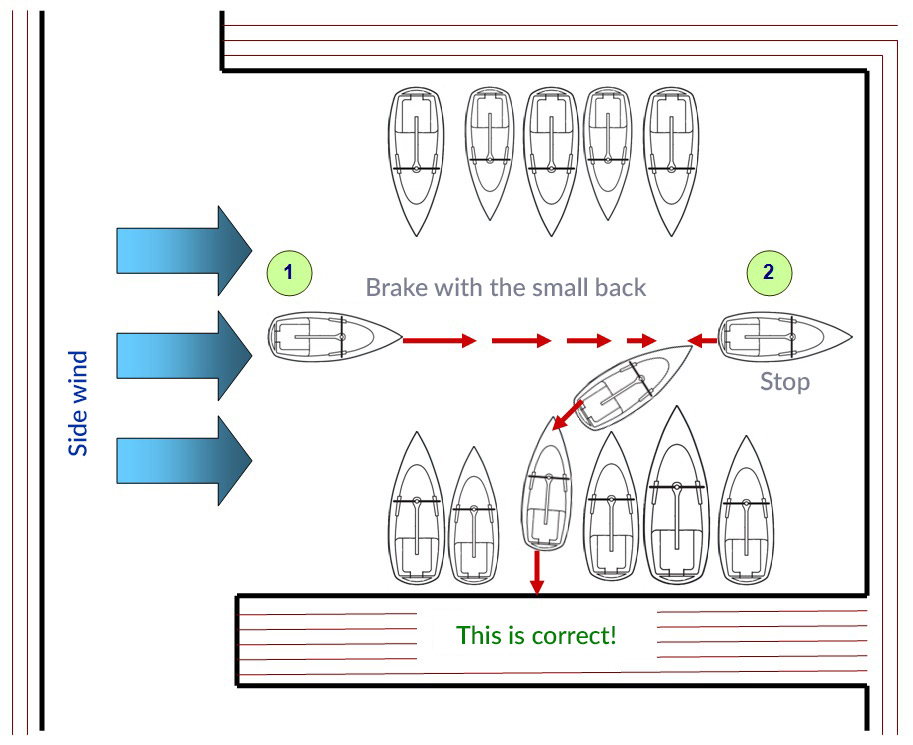
To do this, we will smoothly and in advance start reducing the boat’s speed in reverse to
stop the boat slightly further away from the docking spot (pos. 2). We don’t need to
worry about prop walk in reverse because it is hardly noticeable in «idle reverse.»
The boat will slowly come to a stop and «hang» in place for a while, still having
backward propulsion. I mentioned this effect a few paragraphs ago. When the boat was
moving along the docking corridor, the wind was blowing on its stern and not «confusing»
the bow. Now, when it is about to start moving in reverse from a stable standing
position, the wind will not interfere either since it is blowing on the stern.
After the boat has come to a stop, we will smoothly increase the reverse throttle (to
medium) and start moving in reverse with a turn towards the docking spot against the
wind. As the boat turns, the bow will go into the wind, compensating for the undesirable
wind effect on the light and sail-filled bow of the yacht. But you already know all
this. And that’s all there is to it.
Now, let’s talk about the most important points.
You have probably noticed some things that help control the boat, and now you know the
two main secrets of a successful docking:
First: Approaching and maneuvering stern-first against the wind is
always easier, even if the wind is quite strong.
Second: The direction of the turn towards the docking spot should be
such that the bow of the yacht faces into the wind.
And there are a couple more things to keep in mind.
To reduce the turning radius, you can and should use the effect of throwing the stern. Of
course, only if it helps and directs the stern in the desired direction.
Finally, one more point related to throwing the stern. Throwing the stern in reverse only
occurs when engaging the reverse gear in the «Medium Reverse» or «Full Reverse»
position. That’s why slowing down in «Idle Reverse» allows you to stop the boat without
the stern throwing and excessive movement. Gradually and smoothly increasing the
throttle also helps minimize the stern throwing.
Of course, knowing these principles is not a guarantee of a successful docking. But they
are the «multiplication table» without which success is impossible. These basic
knowledge will help you avoid many unpleasant situations.
So, what’s next? You’ve reached the dock, which is great, but what’s next? Should you go
for the mooring line? Or somewhere else?